GRETCHEN ERTL
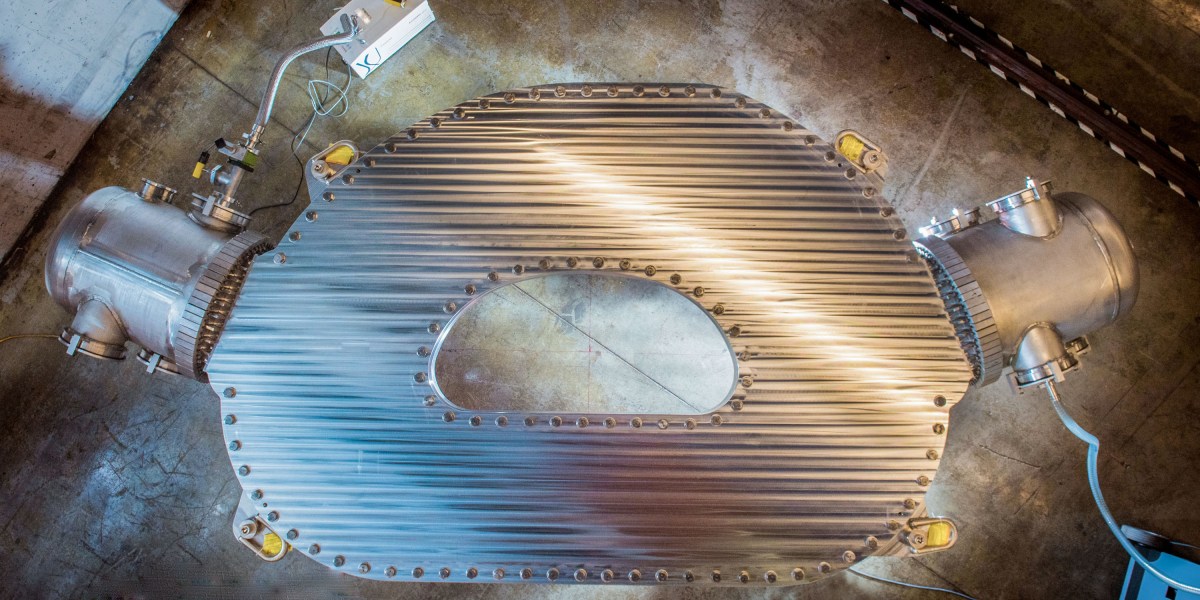
The idea is straightforward: Fill the doughnut with hydrogen gas, and then heat that gas until it turns to electrically charged plasma. In this ionic state, plasma would be held in place by magnets positioned around the tokamak. Achieving fusion on Earth without the immense pressure of a star’s interior, scientists calculated, would require temperatures nearly 10 times hotter than our sun’s center—around 100 million degrees Celsius. So the trick would be to suspend the hot plasma so perfectly in a surrounding magnetic field that it wouldn’t touch inner surfaces of the chamber. Such contact would instantly cool it, stopping the fusion reaction.
The good part about that was safety. In a failure, a fusion power plant wouldn’t melt down—just the opposite. The bad part was that gaseous plasma wasn’t very cooperative—any slight irregularity in the chamber walls could cause destabilizing turbulence. But the concept was so tantalizing that by the mid-1980s, 75 universities and governmental institutes around the world had tokamaks. If anyone could get fusion—the most energy-dense reaction in the universe—to work, the deuterium in a liter of seawater could meet one person’s electricity needs for a year. It would be, effectively, a limitless resource.
Besides turbulence, there were two other big obstacles. The magnets surrounding the plasma needed to be really powerful—meaning really big. In 1986, 35 nations representing half the world’s population—including the US, China, India, Japan, what is now the entire European Union, South Korea, and Russia—agreed to jointly build the International Thermonuclear Experimental Reactor, a $40 billion giant tokamak in southern France. Standing 100 feet tall on a 180-acre site, ITER (the acronym also formed the Latin word for “journey”) is equipped with 18 magnets weighing 360 tons apiece, made from the best superconductors then available. If it works, ITER will produce 500 megawatts of electricity—but not before 2035, if then. It’s still under construction. The second obstacle is the biggest: Many tokamaks have briefly achieved fusion, but doing so always took more energy than they produced.
After earning his doctorate in 1992, Whyte worked on an ITER prototype at San Diego’s National Fusion Facility, taught at the University of Wisconsin, and in 2006 was hired by MIT. By then, he understood how huge the stakes were, and how life-changing commercial-scale fusion energy could be—if it could be sustained, and if it could be produced affordably.
MIT had been trying since 1969. The red brick buildings of its Plasma Science and Fusion Center, where Whyte came to work, had originally housed the National Biscuit Company. PSFC’s sixth tokamak, Alcator C-Mod, built in 1991, was in Nabisco’s old Oreo cookie factory. C-Mod’s magnets were coiled with copper to serve as a conductor (think of how copper wire wrapped around a nail and connected to a battery turns it into an electromagnet). Before C-Mod was finally decommissioned, its magnetic fields, 160,000 times stronger than Earth’s, set the world record for the highest plasma pressure in a tokamak.
As Ohm’s law describes, however, metals like copper have internal resistance, so it could run for only four seconds before overheating—and needed more energy to ignite its fusion reactions than what came out of it. Like the now 160 similar tokamaks around the world, C-Mod was an interesting science experiment but mainly reinforced the joke that fusion energy was 20 years away and always would be.
Each year, Whyte had challenged PhD students in his fusion design classes to conjure something just as compact as C-Mod, one-800th the scale of ITER, that could achieve and sustain fusion—with an energy gain. But in 2013, as he neared 50, he increasingly had doubts. He’d devoted his career to the fusion dream, but unless something radically changed, he feared it wouldn’t happen in his lifetime.
The US Department of Energy decided to scale back on fusion. It informed MIT that funding for Alcator C-Mod would end in 2016. So Whyte decided he would either quit fusion and do something else or try something different to get there faster.
#Dennis #Whytes #fusion #quest #MIT #Technology #Review