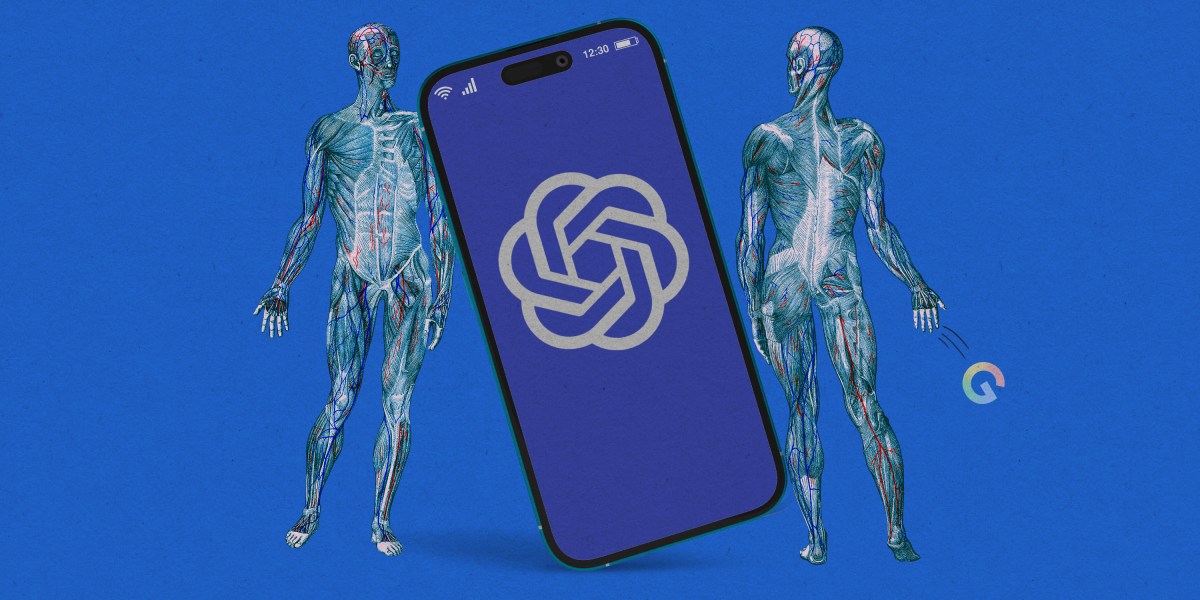
Some doctors see LLMs as a boon for medical literacy. The average patient might struggle to navigate the vast landscape of online medical information—and, in particular, to distinguish high-quality sources from polished but factually dubious websites—but LLMs can do that job for them, at least in theory. Treating patients who had searched for their symptoms on Google required “a lot of attacking patient anxiety [and] reducing misinformation,” says Marc Succi, an associate professor at Harvard Medical School and a practicing radiologist. But now, he says, “you see patients with a college education, a high school education, asking questions at the level of something an early med student might ask.”
The release of ChatGPT Health, and Anthropic’s subsequent announcement of new health integrations for Claude, indicate that the AI giants are increasingly willing to acknowledge and encourage health-related uses of their models. Such uses certainly come with risks, given LLMs’ well-documented tendencies to agree with users and make up information rather than admit ignorance.
But those risks also have to be weighed against potential benefits. There’s an analogy here to autonomous vehicles: When policymakers consider whether to allow Waymo in their city, the key metric is not whether its cars are ever involved in accidents but whether they cause less harm than the status quo of relying on human drivers. If Dr. ChatGPT is an improvement over Dr. Google—and early evidence suggests it may be—it could potentially lessen the enormous burden of medical misinformation and unnecessary health anxiety that the internet has created.
Pinning down the effectiveness of a chatbot such as ChatGPT or Claude for consumer health, however, is tricky. “It’s exceedingly difficult to evaluate an open-ended chatbot,” says Danielle Bitterman, the clinical lead for data science and AI at the Mass General Brigham health-care system. Large language models score well on medical licensing examinations, but those exams use multiple-choice questions that don’t reflect how people use chatbots to look up medical information.
Sirisha Rambhatla, an assistant professor of management science and engineering at the University of Waterloo, attempted to close that gap by evaluating how GPT-4o responded to licensing exam questions when it did not have access to a list of possible answers. Medical experts who evaluated the responses scored only about half of them as entirely correct. But multiple-choice exam questions are designed to be tricky enough that the answer options don’t give them entirely away, and they’re still a pretty distant approximation for the sort of thing that a user would type into ChatGPT.
A different study, which tested GPT-4o on more realistic prompts submitted by human volunteers, found that it answered medical questions correctly about 85% of the time. When I spoke with Amulya Yadav, an associate professor at Pennsylvania State University who runs the Responsible AI for Social Emancipation Lab and led the study, he made it clear that he wasn’t personally a fan of patient-facing medical LLMs. But he freely admits that, technically speaking, they seem up to the task—after all, he says, human doctors misdiagnose patients 10% to 15% of the time. “If I look at it dispassionately, it seems that the world is gonna change, whether I like it or not,” he says.
For people seeking medical information online, Yadav says, LLMs do seem to be a better choice than Google. Succi, the radiologist, also concluded that LLMs can be a better alternative to web search when he compared GPT-4’s responses to questions about common chronic medical conditions with the information presented in Google’s knowledge panel, the information box that sometimes appears on the right side of the search results.
Since Yadav’s and Succi’s studies appeared online, in the first half of 2025, OpenAI has released multiple new versions of GPT, and it’s reasonable to expect that GPT-5.2 would perform even better than its predecessors. But the studies do have important limitations: They focus on straightforward, factual questions, and they examine only brief interactions between users and chatbots or web search tools. Some of the weaknesses of LLMs—most notably their sycophancy and tendency to hallucinate—might be more likely to rear their heads in more extensive conversations and with people who are dealing with more complex problems. Reeva Lederman, a professor at the University of Melbourne who studies technology and health, notes that patients who don’t like the diagnosis or treatment recommendations that they receive from a doctor might seek out another opinion from an LLM—and the LLM, if it’s sycophantic, might encourage them to reject their doctor’s advice.
Some studies have found that LLMs will hallucinate and exhibit sycophancy in response to health-related prompts. For example, one study showed that GPT-4 and GPT-4o will happily accept and run with incorrect drug information included in a user’s question. In another, GPT-4o frequently concocted definitions for fake syndromes and lab tests mentioned in the user’s prompt. Given the abundance of medically dubious diagnoses and treatments floating around the internet, these patterns of LLM behavior could contribute to the spread of medical misinformation, particularly if people see LLMs as trustworthy.
OpenAI has reported that the GPT-5 series of models is markedly less sycophantic and prone to hallucination than their predecessors, so the results of these studies might not apply to ChatGPT Health. The company also evaluated the model that powers ChatGPT Health on its responses to health-specific questions, using their publicly available HeathBench benchmark. HealthBench rewards models that express uncertainty when appropriate, recommend that users seek medical attention when necessary, and refrain from causing users unnecessary stress by telling them their condition is more serious that it truly is. It’s reasonable to assume that the model underlying ChatGPT Health exhibited those behaviors in testing, though Bitterman notes that some of the prompts in HealthBench were generated by LLMs, not users, which could limit how well the benchmark translates into the real world.
#Google #issues #ChatGPT #Health