AALTO
Because of its unique geography, Japan is a perfect test bed for HAPS. Many of the country’s roughly 430 inhabited islands are remote, mountainous, and sparsely populated, making them too costly to connect with terrestrial cell towers. Aalto HAPS is partnering with Japan’s largest mobile network operators, NTT DOCOMO and the telecom satellite operator Space Compass, which want to use Zephyr as part of next-generation telecommunication infrastructure.
“Non-terrestrial networks have the potential to transform Japan’s communications ecosystem, addressing access to connectivity in hard-to-reach areas while supporting our country’s response to emergencies,” Shigehiro Hori, co-CEO of Space Compass, said in a statement.
Zephyr, Aubourg explains, will function like another cell tower in the NTT DOCOMO network, only it will be located well above the planet instead of on its surface. It will beam high-speed 5G connectivity to smartphone users without the need for the specialized terminals that are usually required to receive satellite internet. “For the user on the ground, there is no difference when they switch from the terrestrial network to the HAPS network,” Aubourg says. “It’s exactly the same frequency and the same network.”
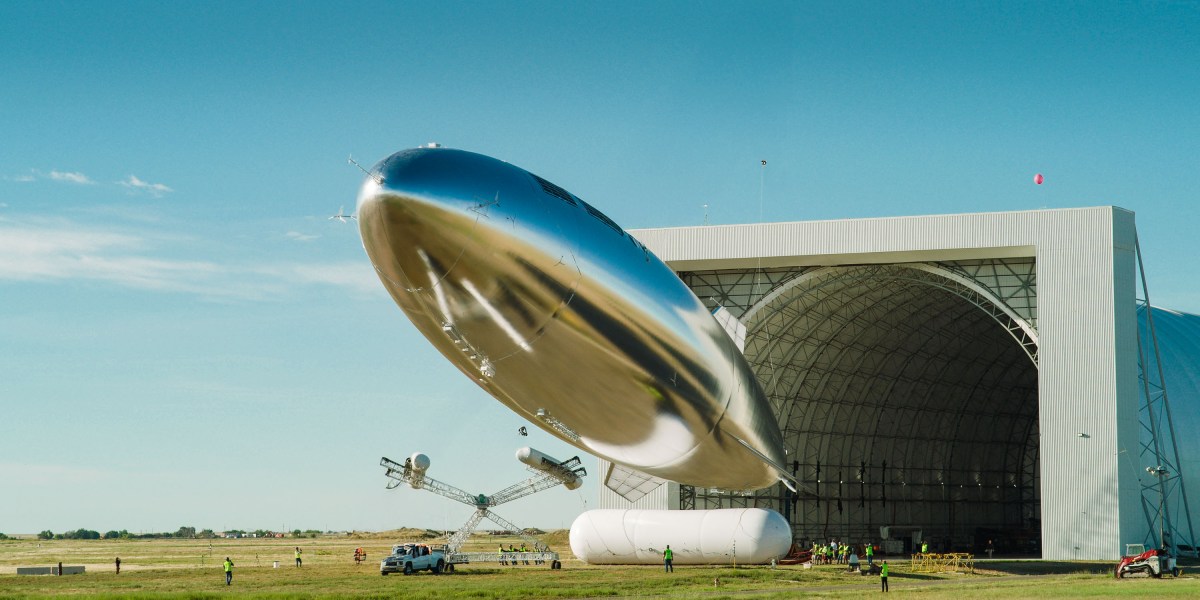
New Mexico–based Sceye, which has developed a solar-powered helium-filled airship, is also eyeing Japan for pre-commercial trials of its stratospheric connectivity service this year. The firm, which extensively tested its slick 65-meter-long vehicle in 2025, is working with the Japanese telecommunications giant SoftBank. Just like NTT DOCOMO, Softbank is betting on HAPS to take its networks to another level.
Mikkel Frandsen, Sceye’s founder and CEO, says that his firm succeeded where Loon failed by betting on the advantages offered by the more controllable airship shape, intelligent avionics, and innovative batteries that can power an electric fan to keep the aircraft in place.
“Google’s Loon was groundbreaking, but they used a balloon form factor, and despite advanced algorithms—and the ability to change altitude to find desired wind directions and wind speeds—Loon’s system relied on favorable winds to stay over a target area, resulting in unpredictable station-seeking performance,” Frandsen says. “This required a large amount of balloons in the air to have relative certainty that one would stay over the area of operation, which was financially unviable.”
He adds that Sceye’s airship can “point into the wind” and more effectively maintain its position.
“We have significant surface area, providing enough physical space to lift 250-plus kilograms and host solar panels and batteries,” he says, “allowing Sceye to maintain power through day-night cycles, and therefore staying over an area of operation while maintaining altitude.”
#Stratospheric #internet #finally #start #year